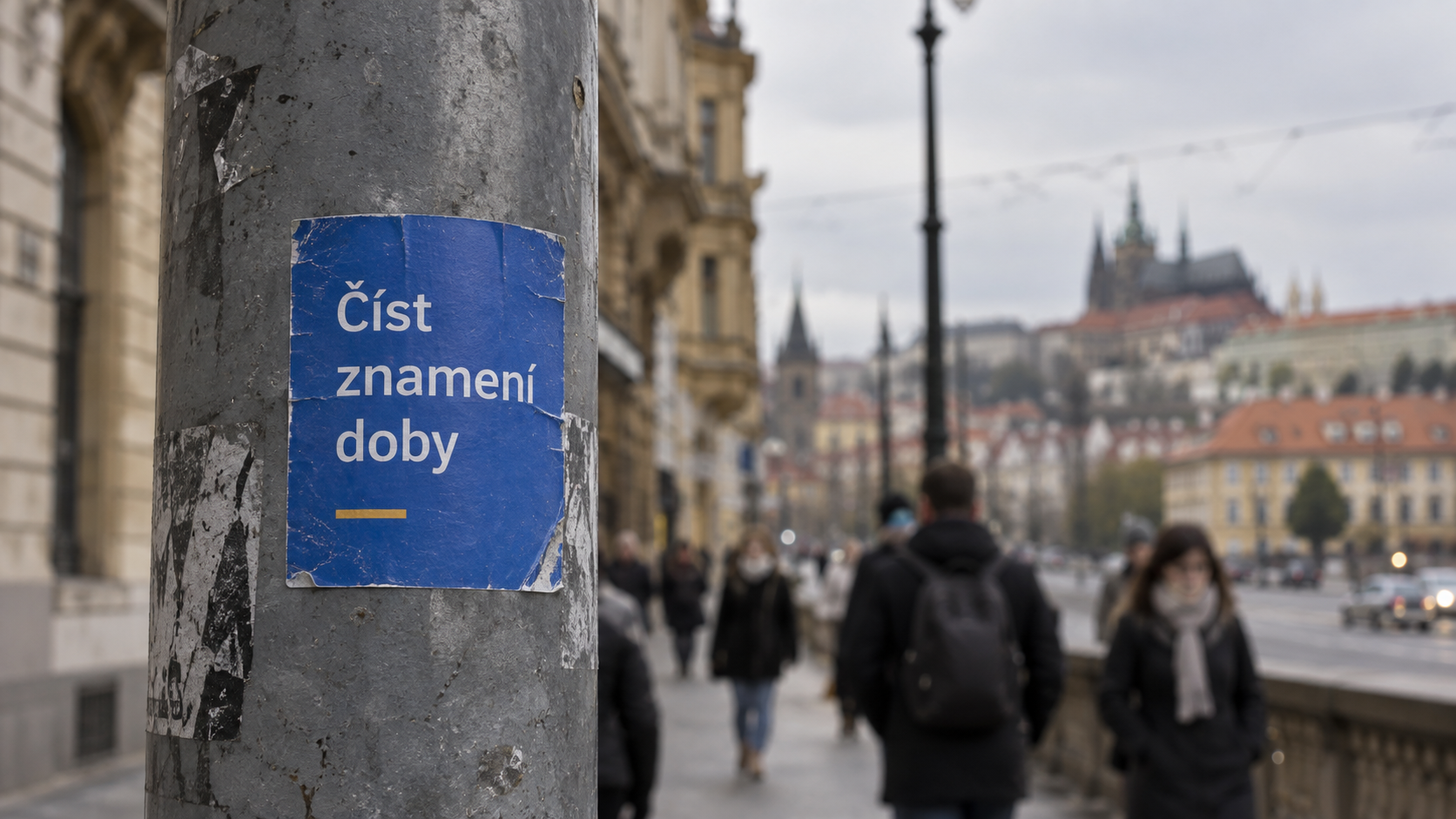
The Church, especially our Catholic Church, has one significant advantage: it doesn't have to panic every time something new arises.
He thinks in terms of centuries. Fashion trends come and go, and technology changes. It's good that we don't jump on every new trend just because it's currently popular.
However, it is precisely here that an important task begins: distinguishing between what is a short-term trend and what represents a genuine shift in the times.
In simple terms: we should know where things are going.
The Second Vatican Council uses a slightly more elevated formulation. The document *Gaudium et spes* states that the Church must "constantly examine the signs of the times and interpret them in the light of the Gospel." We must understand the world in which we live, its expectations, desires, and even its dramatic aspects. [1]
It means having a good understanding of the times in which we proclaim the Gospel.
Almost everything has changed in the last twenty years.
As recently as 2005, only approximately one-fifth of Czech households had internet access – specifically, 19%. By 2025, this figure had risen to 90% of households. [2][3]
Similarly, the way people watch movies and TV shows has changed rapidly. In 2020, approximately 900,000 people in the Czech Republic used paid video streaming services. Four years later, that number had increased to 3.65 million.[4] By 2025, 44% of Czechs aged 16-74 were using paid movie and TV show streaming services.[5]
This is simply a fundamental change in the environment we live in.
And with movies, series, videos, and social media, we're not just consuming entertainment. We're also absorbing stories, values, and ideas about people, relationships, family, guilt, forgiveness, death, hope, or the meaning of life.
That is precisely why the Church has long emphasized that it is not enough to simply use modern media as another channel. The document *Aetatis Novae* from 1992 speaks of the media as a fundamental space for evangelization and calls for an understanding of the new culture they create – its language, mode of communication, and way of thinking. [6]
Perhaps it's not about being trendy.
Often, people talk about what "the church" should do. However, the church is not just about dioceses, institutions, or media organizations.
The church is all of us.
And it is precisely we who should be able to understand where people are spending their time today, where they get their stories from, and what shapes their worldview.
It doesn't mean abandoning what works. Nor does it mean blindly chasing algorithms and fleeting trends.
The problem arises when we confuse caution with inaction – or when we continue to consider something that is no longer an experiment as a marginal area.
If we want to stay ahead of the curve, we believe that professional work in social media, public relations, and digital content should be a much higher priority, as well as systematic audiovisual production. It's often said that we are living in the age of video. Videos and films simply dominate the media landscape.
We urgently need high-quality films, documentaries, series, and other content that can stand out not only within the Christian community but also on mainstream commercial platforms, and that can appeal to someone who would never normally choose to watch a Christian media outlet.
We also need our own digital spaces where we can develop and offer such content over the long term.
This idea is also the foundation of Filmana. It's a response to the question of where and how people actually consume audiovisual content today. Its aim is to provide a platform for films and stories that can naturally explore themes of faith, hope, relationships, and the meaning of life, within an environment that resonates with modern audiences.
The Filman Foundation's ambitions extend beyond the streaming platform itself. In the long term, we aim to significantly contribute to the creation of high-quality audiovisual content that is both technically proficient and artistically valuable, and which presents a Christian perspective on humanity and the world, even in contexts where it may reach a wider, often secular audience – in cinemas, television broadcasts, commercial streaming services, and other media platforms.
Reading the signs of the times.
Perhaps we don't need to be "modern" at all costs.
We need to be attentive.
It's important to distinguish between what is simply a passing trend and what has truly changed the world around us. We need to pay attention to where people are today, what they are watching, and who is shaping their imaginations.
Then, simply ask yourself this question: Are we also included in that?
Not in order to simply copy the world around us, but so that we can bring what has been entrusted to us into it.
Perhaps that is what it means to read the signs of the times.
And sometimes, it's also important to know which way the rabbit is running.
Jan Perout.
Sources.
[1] Second Vatican Council: Gaudium et
Spes, Article 4.
https://www.vatican.va/archive/hist_councils/ii_vatican_council/documents/vat-ii_const_19651207_gaudium-et-spes_cs.html
[2] Czech Statistical Office: How many
households in the Czech Republic have a computer and internet access? – In 2005, 19% of Czech households had internet access.
https://csu.gov.cz/kolik_domacnosti_v_cr_ma_pocitac_a_internet
[3] Czech Statistical Office: Information and
Communication Technology (ICT) in Households and ICT Users, data for the year 2025 – 90% of households had internet access.
https://csu.gov.cz/ict-v-domacnostech-a-uzivatele-ict
[4] Czech Statistical Office, Statistics &
You, Issue 2/2025 – The number of people watching paid video content online increased from approximately 900,000 in 2020 to 3.65 million in 2024.
https://csu.gov.cz/docs/107508/c3112a88-112e-ba2e-9828-3b6e247be8e1/3201852502.pdf
[5] Czech Statistical Office / Eurostat:
The Information Society in Figures 2026 – In 2025, 44% of the Czech population aged 16-74 years streamed paid movies or programs.
https://csu.gov.cz/docs/107508/b0ac78fb-d520-c641-dc54-81270d769e8b/06100426.pdf
[6] Pontifical Council for Social Communications:
*Aetatis Novae*, article 11, 1992.
https://www.vatican.va/roman_curia/pontifical_councils/pccs/documents/rc_pc_pccs_doc_22021992_aetatis_en.html